IT3 System Technology
What is the IT3 System?
IT3 refers to Internal Tube 3-Phase in a multiwall piping configuration which consists of 3 components: a smaller plastic pipe (liner) inserted into a larger diameter steel or other hard material (casing) with a cement grout injected between the OD of the liner and the ID of the casing (annulus). The primary objective in this superior piping application is the implementation in virtually all pipe line configurations where reducing, neutralizing and eliminating internal corrosion is imminent.
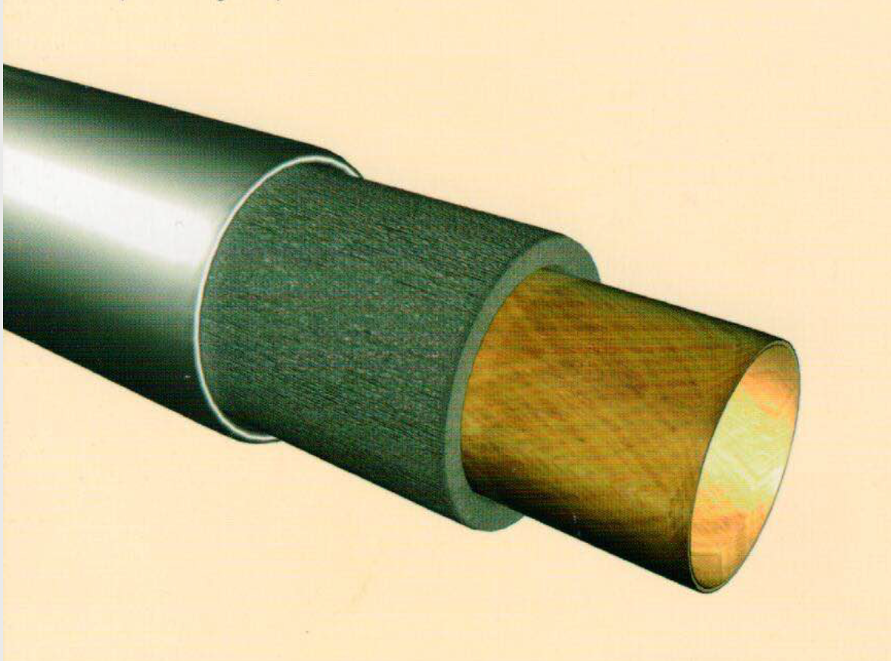
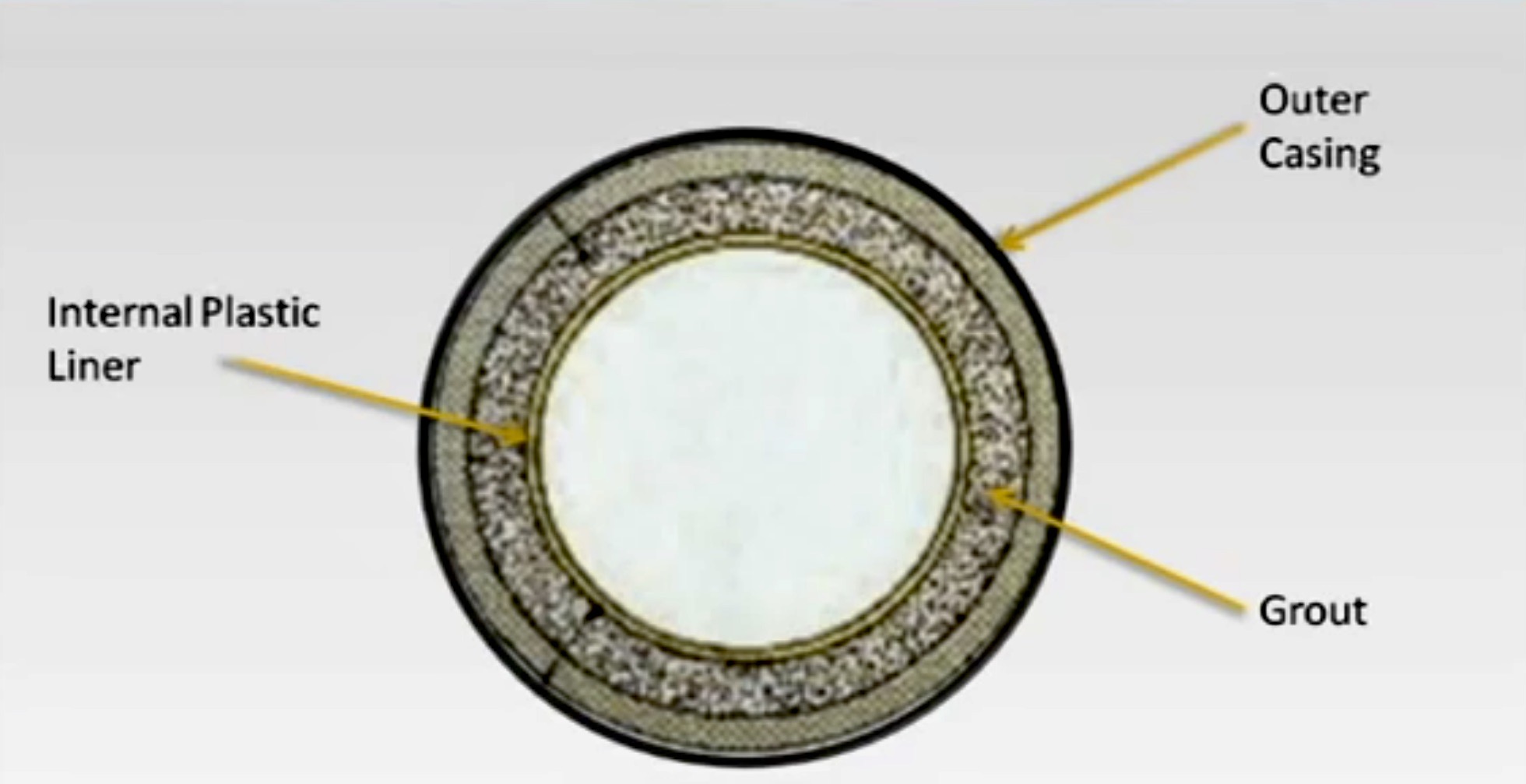
The trade name IT3 short for Internal Tube 3-Phase reflects the three distinct material layers integrated into its design. This innovative multiwall piping system, originally patented by Ken Tierling over 50 years ago, demonstrates the advanced approach to manufacturing and installation techniques for demanding industrial environments.
Interactive 3D Model
Click and drag to rotate • Scroll to zoom • Right-click to pan
Interactive 3D IT3 System Model
4-Layer Pipe System Cross-Section
Pipe Layers
Compressed Liner Classification
"The design is classified as a compressed liner since the plastic to steel conformity is not derived from altering the polymer component."
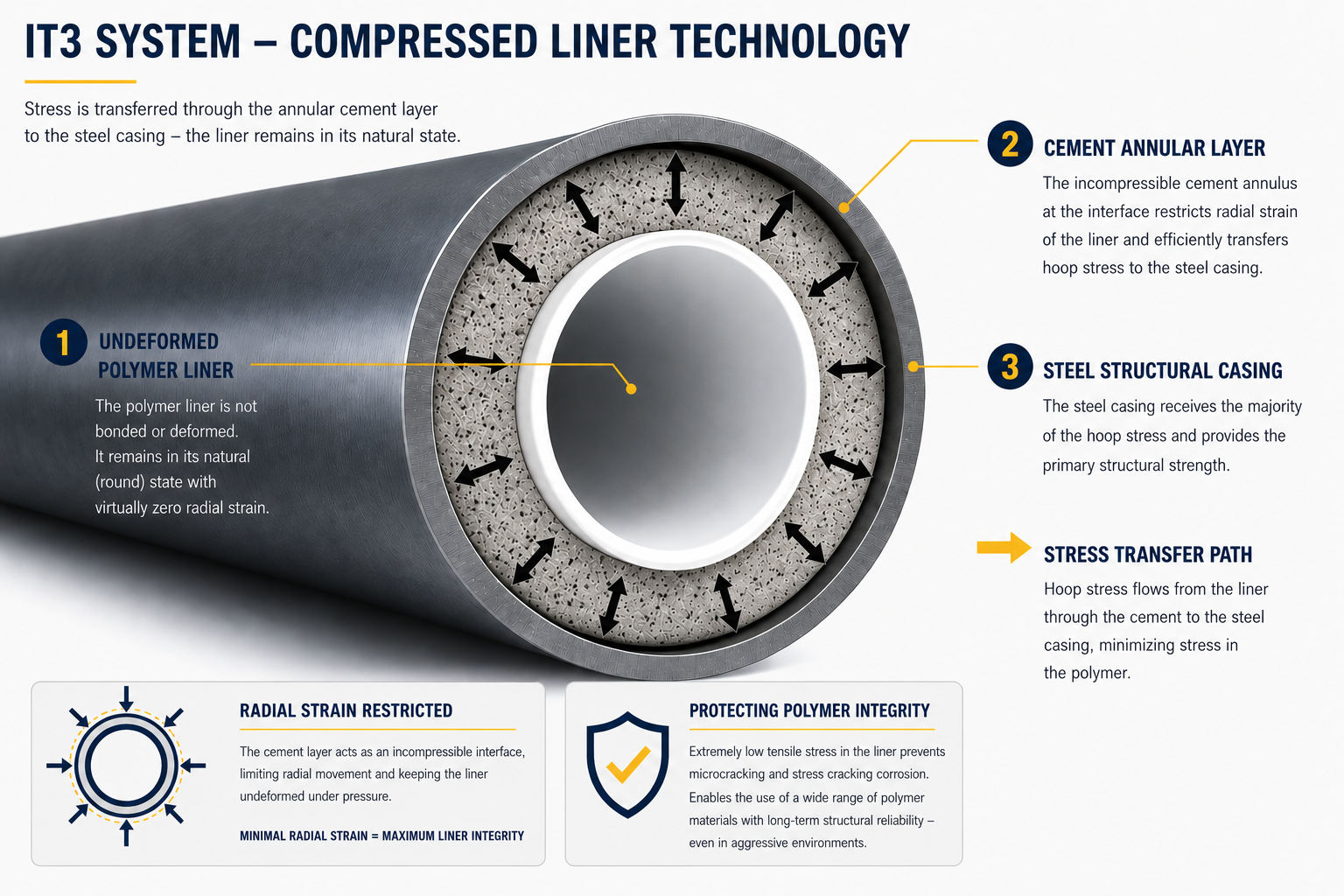
The IT3 System design is based on the concept that the liner is not directly bonded/fixed to the ID of the steel casing through deformation which does not affect its natural state. Through this unique concept the design is classified as a compressed liner since the plastic to steel conformity is not derived from altering the polymer component.
In relation to the plastic inner pipe, the design is classified as a compressed liner since the plastic to steel connection is not derived through the deformation of the polymeric component. Basically, the design inserts an incompressible material at the interface thereby totally limiting radial strain of the inner polymer pipe. As a result, the cement annular transfers the majority of stress to the outer casing and perfectly anchors the inner pipe.
Due to the extremely low stress in the tensile mode, actuation of microcracking in the plastic is entirely avoided. Thus, the IT3 System enables numerous polymeric materials to be successfully implemented without jeopardizing their structural integrity. Furthermore, polyethylenes even in the presence of surface-active agents, elude all possibility of the familiar stress cracking corrosion failure mode occurring due to the absence of any significant degree of stress.
Technical Example
By intentionally disregarding the compressive effect of the cement on the inner liner during its set, a specific instance using a P.V.C. liner illustrates the magnitude of stress to be projected in the liner and steel layers:
Liner Performance
Steel Stress Comparison
The Crucial Component: Neat Cement Grout
"Once injected and cured in the annular space, the cement combines the two conduits into one multiwall pipe — the most advantageous solution for double-wall containment."
The most crucial and fundamental component is the specific neat cement grout formula that once injected and cured in the annular space it combines the two conduits into one multiwall pipe. This makes the IT3 System the most advantageous solution that meets or exceeds double wall containment requirements.
Key Properties of the Cement Grout
- ▸High modulus of elasticity in compression (2.0–3.0×10⁶ psi)
- ▸High compressive strength (8,000–10,000 psi)
- ▸Low shrinkage value
- ▸Hydraulic set — external heat not required to cure
- ▸Similar thermal expansion to steel
- ▸Optimum flow properties
Functions of the Cement Grout
- ▸Combines the two conduits into a unified multiwall pipe
- ▸Meets or exceeds double-wall containment standards
- ▸Provides hoop strength transmission for structural integrity
- ▸Serves as a secondary corrosion barrier
- ▸Offers negative buoyancy, enhancing stability in submerged environments
- ▸Acts as a thermal insulator
Manufacturing Options
Factory Manufacturing
The multiwall pipe can be manufactured in double-random lengths in a plant, ensuring precise quality control and consistent production standards.
In-Situ Installation
Alternatively, it can be installed in-situ, using existing pipelines as the outer containment layer. This proprietary process revitalizes existing pipelines, restoring them to optimal performance and operating standards.